




Introduction
When choosing a projector, many users focus on the resolution or the brand…
However, there is one criterion that is often underestimated but is decisive: light output.
A projector with inadequate brightness can render an installation unusable:
- The image is too dark.
- lack of contrast
- eye strain
Therefore, luminous intensity is a key element to ensure a comfortable and professional visual experience.
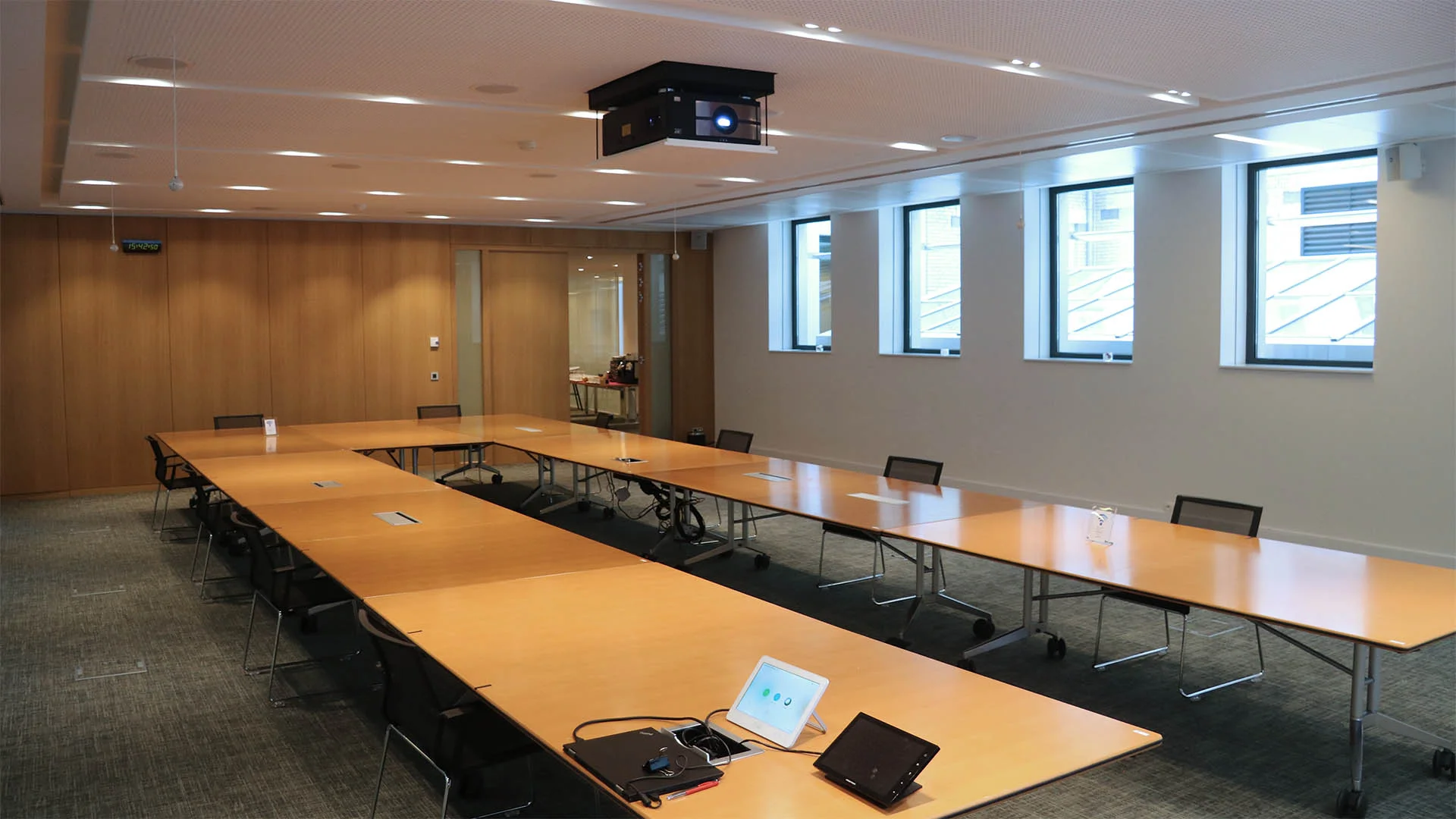
What is the luminous power of a projector?
The luminous power corresponds to the amount of light that the projector is able to project onto the screen.
It is expressed in ANSI lumens, which is the reference standard for projectors.
The higher the number of lumens:
- the brighter the image
- the longer it remains visible in a lit environment
Why is brightness essential?
Unlike a conventional screen, a projector is highly dependent on its environment.
Inadequate lighting can cause:
- a bland image
- muted colors
- a loss of legibility
Conversely, good luminous power allows:
- maintain ambient lighting
- improve user comfort
- to make meetings more dynamic
How is the ideal luminous power calculated?
The luminous power depends directly on the size of the screen.
Basic rule used in the audiovisual sector:
≈ 2200 ANSI lumens per m² of screen
Concrete example 1: 2-meter screen
- width: 2 m
- height: 1,125 m
- surface area: 2.25 m²
Recommended power:
2.25 × 2200 = ± 4950 ANSI lumens
Specific example 2: 1.5 meter screen
- surface area: 1.28 m²
Recommended power:
1.28 × 2200 = ± 2770 ANSI lumens
Factors to consider
The theoretical calculation is a reference point, but several factors influence the final decision:
01. The brightness of the room
- dark room → fewer lumens are needed
- bright room → requires more power
02. The use
- PowerPoint presentation → moderate lighting
- detailed video or image → greater brightness
03. Screen size
- The larger the image, the more the light will be "diluted".
04. Visual comfort
The human eye perceives a brighter image as:
- clearer
- higher quality
Common mistakes
Undersize the power
the most common case
Result:
- image difficult to read
- frustrated users
Unnecessarily oversize
Specific case (professional use)
Classic meeting room:
Recommendation:
This allows:
Cas usage home cinema
dark room:
priority:
Luminous power and perceived quality
One aspect that is often overlooked:
- A brighter image is perceived as sharper, even if the resolution does not change.
This means that:
- Increasing the brightness can sometimes be more effective than switching to 4K.
Conclusion: How to choose well?
Things to keep in mind:
- base: 2200 lumens/m²
- adapt to the environment
- Ambient light should not be overlooked
- Think about the actual use before the technical specifications
The opinion of the AV Application experts
Each installation is unique.
At AV Application, we analyze:
- the work
- the use
- the type of content
to offer a perfectly tailored solution, without unnecessary additional costs.